
At the age of six I asked my mum for piano lessons. My
parents were unsure where this aspiration had come from since most of my family
were musically illiterate and no-one had expressed any interest whatsoever in
playing an instrument. Four years and many piano lessons later, I overhead my
father mention in conversation with a neighbour that my great-grandfather James
Aloysious (known as Curly) had been very musical. He played the piano and the
mandolin.
When I asked my father about James he told me how my aunt
would sit on James’s lap at the piano and place her tiny hands over his hands
while he played the keys. He mentioned how James's hands were rough and his
knuckles were beaten up from the fights.
I thought that was an odd thing to say, ‘from the fights’.
My father showed me a photograph of James in his later years
and I was struck by the resemblance. He looked exactly like my father - and, in
turn, like me. It gave me an unexpected sense of connection and I pestered my
father to tell me more about James’s life. And the more that I discovered about
him, the more I found him to be a fascinating individual.

James lived in Harborne, he was ex-army and a bare-knuckle
fighter at Smethwick market. Every Sunday morning he would walk from Harborne
to Smethwick to fight, returning home with silver win money to give to his wife
Florie and keeping the copper coins for himself as beer money. He made a decent
living from it and the family were looked after because they were in with 'the
right crowd' and knew 'the right people', although the company that James kept
seemed very dubious indeed.
A number of shady characters appeared in my father’s stories, such as the mysterious Italian Mr Mansini who found my grandfather a job after the war by sending him to a local factory with nothing but a handwritten note saying that he had been sent by Mr Mansini. The note alone was a guarantee of a job and the gesture was made because my grandfather was Curly’s son and 'Curly and his family were to be well looked after.'

But the most memorable – and disturbing - detail that my
father shared was this; if James went out for the day with his family then he
would wear his ‘home cap’, but if he went out of the house on an evening
wearing his ‘working cap’ then my great-grandmother would wait up all night
watching from the front bay window of the house until he came home. If James
went out wearing his working cap then she knew there was going to be trouble.
When I asked about the significance of the caps, my father explained that the
working cap had razor blades sewn in the rim which came in handy if there was
ever a fight. And, by the sounds of it, there were lots of fights.
James played the mandolin at the Green Man pub in Harborne
and one evening a huge fight broke out between his friends and the police. It
seemed to have been some kind of sting operation targeting them all. James took
out three policemen, he smashed his mandolin over the head of one policeman
(thereby ending his musical career) and threw another policeman through the
front window of the pub into the horse road outside. The police took James to
Steel House Lane police station where he 'fell down the steps of the police
station' and my great-grandmother claimed that he was never quite the same
again afterwards.
 |
| Note on the back of a photo of my great-grandfather |
I remember this conversation being both horrified and
spellbound by these stories. The thought of slashing someone's face with razor
blades gave me nightmares (I must have been about 10yrs old at the time!) and
yet my father spoke matter-of-factly about it all and with such an oddly warm
affection towards the men in the stories.
I had heard both my father and my grandfather mention the
words ‘peaky blinder’ before and I didn’t understand, or much care at the time,
who they were referring to. But it started to make sense. My father and
grandfather spoke kindly about James and his friends because they had
‘principals’. They were loyal and protective with a strong family-like bond and
they would watch out for one another. I took comfort in knowing that my surname
would keep me safe if I ever crossed paths with one of these suspicious characters
on the street.

On my mother’s side of the family there was my
great-grandfather Sam Richards. Sam’s portrait hung on the wall in my
grandparents’ front room and he was gentle-looking man wearing a sharp business
suit, slicked-back hair and a kindly smile. Sam started out as a boxer, then he
became a book maker and eventually the owner of a large boxing ring in Selly
Oak. Though deeply involved with illegal bookmaking, he presented a
business-like front to his activities and he clearly had the police firmly
under his influence. The police would tip him off before a raid and they would
bang on the wall of the house whenever he needed to clear the house. My
grandmother was often dispatched to the bottom of the garden with a doll’s pram
full of betting slips. Sam made a great deal of money, he bought local
property, became a freemason and he contributed to the community by buying
shoes for local orphans. He didn’t hide his success, once causing a scandal by
buying my grandmother a silver-handled umbrella (which she subsequently left on
a bus).
 |
| Sam (left) and business associates |
My mother recalls that the words ‘peaky blinders’ were banded around the household when she was a child and she was aware that Sam mixed equally with both well-heeled individuals and shady groups who protected his business. The Curlys of the world were on Sam’s payroll rather than his drinking buddy in the pub - in fact it became a running joke in my household that my father’s family were on the rough-and-ready, 'practical' side of the Birmingham gangs, whereas my mother’s family were much more discreet with their dealings and ‘higher up the food chain’!
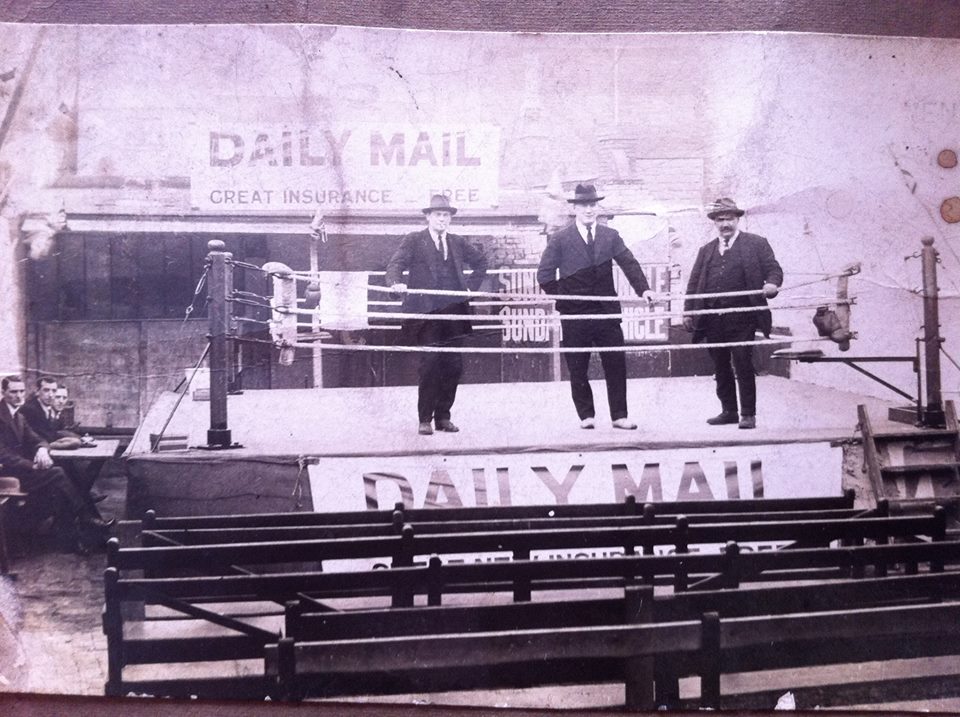 |
| Sam Richards (centre) and his boxing ring |
 |
| Wood block ID photo stamp used by Sam to get into the horse races |
I vividly remember the stories that my grandparents told me
about Birmingham in that era and I have portraits and photographs of James and
Sam and assorted paraphernalia from their lives. Most of all I remember the old
houses, the smell of wood and tobacco, the strange turns of phrase when they
spoke, the way their humour intertwined with violence and the physicality of
close friendships. I remember visiting my great-aunt, who lived past one
hundred, and seeing how she kept her old terraced house perfectly preserved,
with a rocking chair in front of an open fire, lace antimacassars on
the armchairs and a freezing outside toilet. I remember Luigi, my Italian
godfather, and how friends would laugh at the idea of having an Italian
godfather looking out for me. I remember the men that regularly visited my
grandad’s house, how big and scary they were, yet well dressed and friendly and
unfailingly polite to the women of the house. How one of them would squeeze my
knees to make me laugh every time he visited. It would hurt and I could never
wriggle away from him, but he made me laugh so much.

These days, aside from modernised houses and shifting times,
things haven’t changed much in some areas of Birmingham. I grew up on an estate
in Birmingham not far from where Curly and Sam lived. It could be a violent
place but the locals valued strong generational links forged between
influential families that looked out for each other. Loyalty and family names
still carry a great deal of weight and your reputation follows you
around. I’ve worked in funeral parlours and mental asylums, swanned
around masonic halls in ballgowns, listened to security experts lecture me
on the latest developments in bio weaponry, held the keys to churches and gin
bars, dated spies and had partners bring undercover police along to romantic
nights out in case I wasn’t the friendly gal I promised to be. Sometimes your
history can be both a blessing and a curse.
 |
| Death threat, slipped into an enemy's pocket |
So when I heard that a TV series was being made about the
Peaky Blinders I was filled with strange mix of emotions and expectations
because I felt as though someone was making a documentary about a close friend
or relative. A writer unfamiliar with the true spirit of the blinders could be
tempted to ridicule them or cast them as heartless gangsters. However I wasn’t
disappointed. In fact a great deal of content made me smile because it cut very
close to home. Pretty bang-on in some cases. I’m pleased that the series didn't
shy away from the brutal, chaotic violence that these men were predisposed to
because that was certainly the case from the stories that I heard growing up.
But it also highlighted the strong allegiances, friendships and family ties
between the gang members.
The only thing I found missing was the vicious humour that
these men had - the constant joking around and the casual way that serious
matters, such as injury, incarceration or even death, were laughed about. I saw
this raw humour in my grandfather’s friends and older family members and these
days I am chastised by friends for having the same sense of humour and outlook
on life. For this reason the character of Arthur is the most authentic
character by far, if only for the speed in which he switches between banter and
vicious attack.
 |
| A 19thC Small Heath pub token, use to pay for drinks and for groups to recompense the landlord for the use of recreational facilities and back rooms for group meetings |
 |
| Sick Society token, entitling the bearer to financial support to see a doctor or help with burial costs for himself, wife or child |
But the greatest accomplishment of Peaky Blinders is that it
portrays the central characters as both hero and villain thereby giving the
viewer the uneasy experience of both fearing and admiring them, which was the
exact same uncomfortable feeling that I grappled with upon learning about my
family connections with the blinders as a child. James’s working cap gave me
more than a few nightmares as a child, but there are aspects of his personality
and values that I admire and I see within myself these days. Perhaps my
fondness for James, Sam and their friends is borne out of a realisation that
although they were violent men who sailed on the wrong side of the law, they
also had strong family values, they were loyal to those who were loyal to them
and they would protect their friends and loved ones at all costs – all values
that our modern-day society would do well to aspire to.
(Interestingly, my auntie tells me that James’s death was
quite a talking point. The story goes that a gypsy came into the Green Man pub
in Harborne and started reading palms. James paid her to read his palm, she
took one look at his hand and refused, then left the pub straight away.
James died only days afterwards).
Helen Ingram (@drhingram)
